Thommanon vs Chau Say Tevoda Temple - Two Temples, One Short Walk, Zero Regret!
Seeing both gives guests a clear view of two styles in one easy stop!
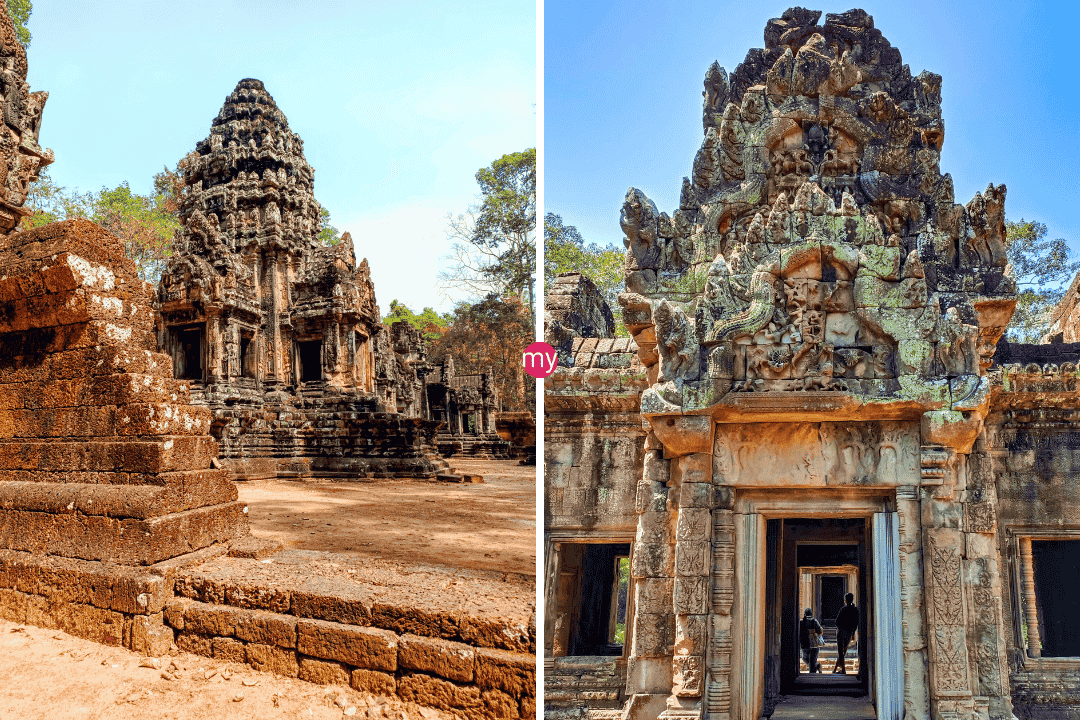
Thommanon vs Chau Say Tevoda Temple represents the perfect comparison study in Angkor Wat architectural styles – Thommanon showcases compact symmetry with exceptional devata carvings, while Chau Say Tevoda offers expansive courtyards with intricate restoration details.
Both temples take just 20-30 minutes each to visit, they’re literally a 2-minute walk apart, and our Private Angkor Wat Small Circuit Tour includes both temples along with five other stunning sites in one incredible day. Seeing both gives you a clear view of two restoration approaches, two architectural interpretations, and twice the perspective on Khmer artistry – all without adding extra time or complexity to your itinerary.
What Makes Thommanon vs Chau Say Tevoda Temple Worth Comparing?
A Thommanon vs Chau Say Tevoda Temple comparison typically involves examining two mirror-image Hindu temples from the same era, built under King Suryavarman II’s reign, positioned directly opposite each other on Victory Way. The temples share similar architectural DNA but reveal fascinating differences in layout complexity, restoration approaches, carving styles, and current preservation states.
Standing between these two temples, you’re at a unique crossroads in Angkor’s landscape. Most visitors rush past one or both, chasing the famous names like Ta Prohm or Bayon. But here’s what the guidebooks skip: this pairing offers something rare – the chance to see identical architectural intent executed with subtle but meaningful differences. Think of it as nature vs. nurture for ancient temples.
The strategic positioning isn’t accidental. These temples flanked the processional route leading to Angkor Thom’s Victory Gate. Imagine royal processions passing between them, warriors returning from battle, religious ceremonies marking seasonal changes. Both temples witnessed the same history from opposite viewpoints.
Which Temple Should You Visit?
Visit both temples – they’re 50 meters apart and together take less than an hour. Thommanon vs Chau Say Tevoda Temple isn’t about choosing one over the other; it’s about understanding Angkorian architecture through comparison. Thommanon was restored by the French (1960s), showing compact elegance with pristine devata carvings. Chau Say Tevoda was restored by China (2000-2009), revealing extensive courtyards with more visible modern intervention.
Both temples appear on our Angkor Wat Small Circuit tour, which strategically schedules them during the afternoon when lighting hits their sandstone perfectly and crowds thin out significantly.
Key Features of Thommanon vs Chau Say Tevoda Temple
Understanding Thommanon vs Chau Say Tevoda Temple requires looking at what makes each unique while recognizing their shared heritage:
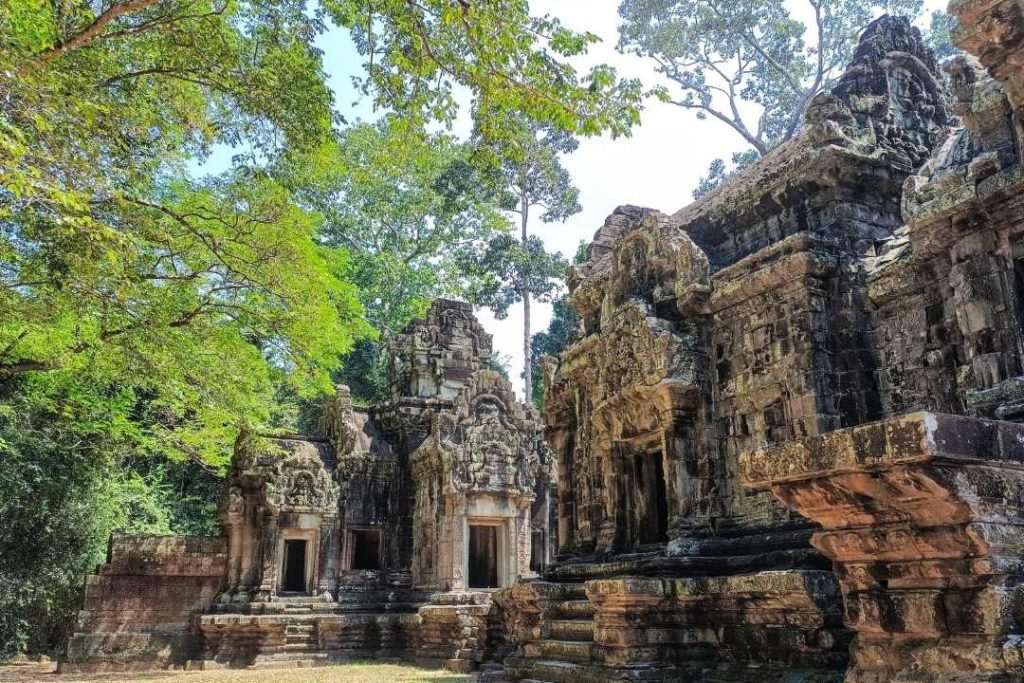
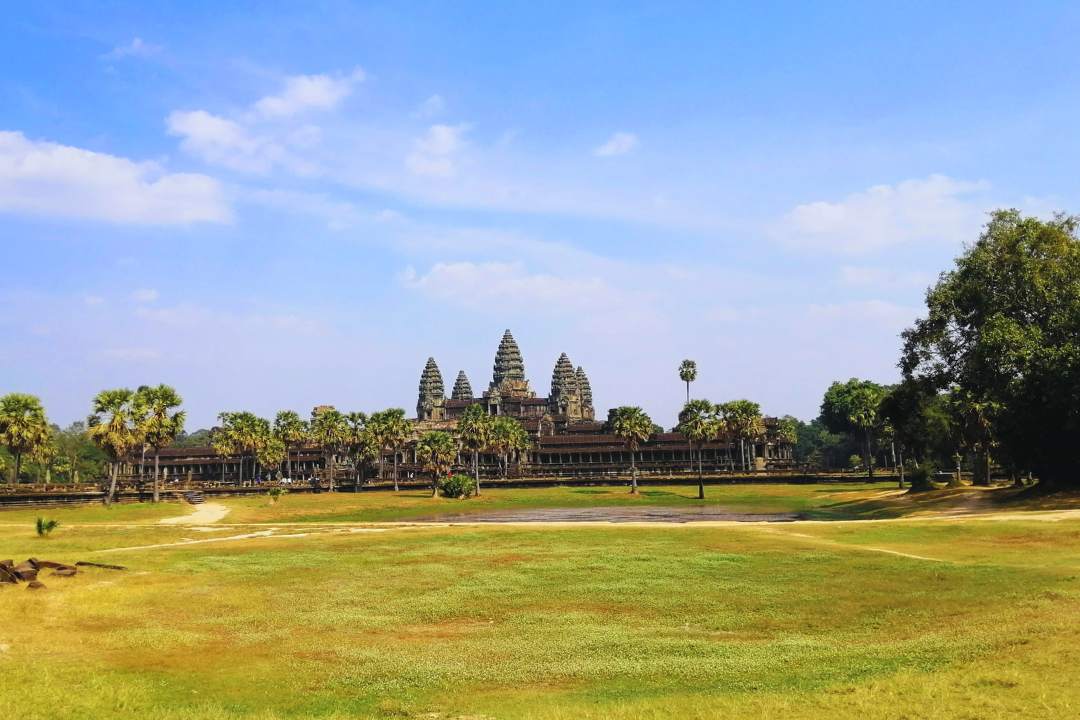
Architectural Layout Differences Thommanon presents a compact, symmetrical design that feels intimate and cohesive. The central sanctuary, libraries, and enclosure walls create a self-contained spiritual universe. Walking through Thommanon, you complete the circuit in about 20 minutes, yet every angle reveals new carved details. The temple feels complete, finished, intentional.
Chau Say Tevoda spreads out more generously. The courtyards between structures create breathing room, contemplation spaces. You notice the expansiveness immediately – this temple wants you to slow down, to pause between buildings. The layout suggests ceremonial processions, multiple participants, larger gatherings.
Restoration Philosophy Comparison The French restoration of Thommanon followed anastylosis principles strictly – only original stones, minimal new material, preservation of authenticity above all. Result? The temple looks remarkably intact but shows its age with grace. Some sections remain incomplete where original materials couldn’t be recovered.
China’s restoration of Chau Say Tevoda took a more interventionist approach. New sandstone fills gaps, reconstructed sections complete the visual narrative, structural reinforcement ensures longevity. The temple looks more “finished” but reveals its restoration more obviously. Neither approach is wrong – they represent different conservation philosophies.
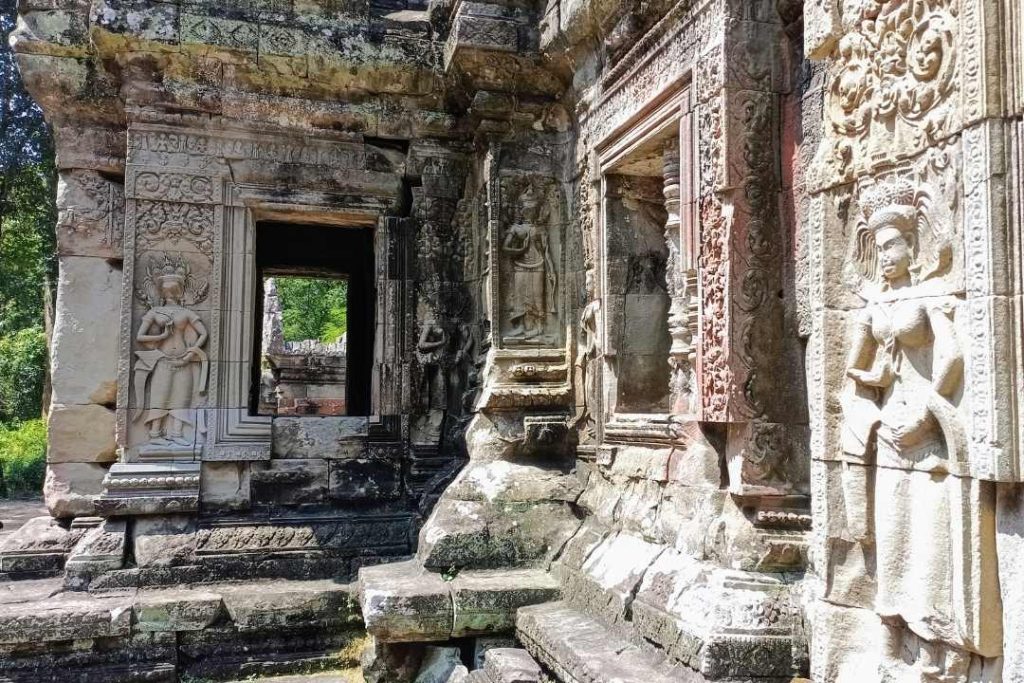
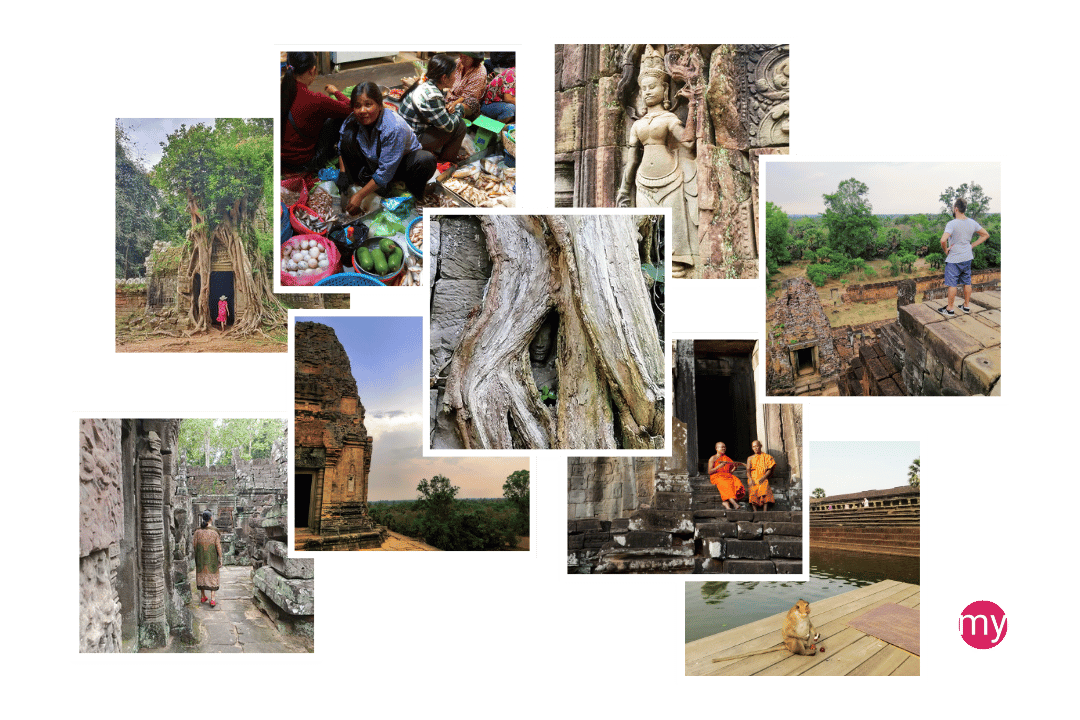
Devata Carving Mastery Thommanon’s devatas (celestial female figures) rank among Angkor’s finest. The sculptors working here achieved something special – faces with subtle expressions, jewelry with impossible delicacy, poses that suggest movement frozen in stone. Photography enthusiasts spend serious time capturing these details. The afternoon light (when our tours visit) highlights every carved fold of fabric, every finger position.
Chau Say Tevoda’s carvings show equal technical skill but less preservation perfection. Some faces have weathered smooth, some details have softened. Yet this weathering tells its own story – centuries of monsoons, vegetation, time itself leaving marks.
Visitor Experience and Crowd Dynamics Thommanon sees more visitors because it’s positioned on the standard circuit route’s right side – the side most tours travel first. Mornings especially bring steady streams. But here’s the insider knowledge: between 2-4 PM, when we schedule this stop on our Small Circuit tour, both temples practically empty out. You’ll have these masterpieces largely to yourself.
Chau Say Tevoda remains quieter throughout the day. Its position across the road requires intentional decision-making – guides must specifically choose to include it. Many skip it entirely, assuming redundancy. Their loss becomes your gain – photographers can set up tripods without dodging crowds, contemplative visitors can sit undisturbed.
Historical Context and Original Purpose Both temples served as Hindu sanctuaries dedicated to Shiva and Vishnu, built during Angkor’s golden age when resources flowed freely and artistic ambition knew few limits. The Thommanon vs Chau Say Tevoda Temple pairing likely represented balance – architectural symmetry reflecting cosmic order.
Religious rituals would have involved both temples in coordinated ceremonies. Processions crossing between them, offerings made in parallel, priests maintaining spiritual equilibrium. Understanding this dual function changes how you experience each temple – they’re not independent monuments but parts of a larger sacred geography.

Thommanon vs Chau Say Tevoda Temple: Side-by-Side Comparison
| Feature | Thommanon Temple | Chau Say Tevoda Temple |
|---|---|---|
| Restoration Period | 1960s (French) | 2000-2009 (Chinese) |
| Layout Style | Compact, symmetrical | Expansive, courtyard-focused |
| Carving Condition | Exceptional preservation | Variable, some weathering |
| Typical Crowd Level | Moderate to high | Low to moderate |
| Photography Time | 15-25 minutes | 20-30 minutes |
| Best Lighting | 2-4 PM | 2-5 PM |
| Restoration Visibility | Minimal modern intervention | More obvious reconstruction |
| Unique Highlight | Pristine devata carvings | Expansive spatial experience |
What Tours Include Thommanon vs Chau Say Tevoda Temple?
When researching Thommanon vs Chau Say Tevoda Temple access, you’ll find most comprehensive Angkor tours include both temples as part of the Small Circuit route:
Private Angkor Wat Small Circuit Tour
Our flagship option includes both temples positioned strategically in the afternoon itinerary. After visiting the major sites (Angkor Wat, Bayon, Ta Prohm), the schedule intentionally places these temples when lighting conditions peak and crowds disperse. The tour includes seven temples total, monk blessing at Prasat Preah Palilay, and runs 9-10 hours with pricing from $79 per person for groups of two.
1-Day Angkor Wat Small Loop Private Tour
 Another excellent choice that covers the essential Small Circuit route with both temples included. This tour focuses on efficiency without rushing, allowing adequate time at each stop for photography and exploration. The guide provides context about the Thommanon vs Chau Say Tevoda Temple relationship that you won’t find in guidebooks.
2-Day Complete Angkor Experience
For travelers wanting deeper immersion, this spreads the Small Circuit across two days, allowing more leisurely pacing. The second day timing means you can visit Thommanon and Chau Say Tevoda during the golden hour when warm light transforms the sandstone.
Angkor Wat and Angkor Thom Tour
This comprehensive full-day option includes both temples as part of the broader Angkor Thom area exploration. The tour adds flexibility – guests can request extended time at either temple if particular interest develops.
Tours that skip these temples usually focus exclusively on the “big three” (Angkor Wat, Bayon, Ta Prohm) or concentrate on sunset/sunrise experiences. But our philosophy at My Siem Reap Tours prioritizes comprehensive understanding over mere highlight collection.
Things to Consider When Visiting Thommanon vs Chau Say Tevoda Temple
Making the most of your Thommanon vs Chau Say Tevoda Temple visit requires thinking through several factors:
Timing and Light Conditions Morning light (7-9 AM) hits Chau Say Tevoda beautifully, creating long shadows that emphasize architectural details. But morning also brings tour buses in waves. Afternoon (2-5 PM) offers the sweet spot – excellent light on both temples, minimal crowds, comfortable temperatures as the day’s heat subsides.
Our tours time this stop deliberately. After visiting the major temples when they’re less crowded, we arrive at Thommanon and Chau Say Tevoda when conditions optimize. This sequencing isn’t accidental – it’s the product of years observing crowd patterns and light angles.
Comparative Learning Approach The real value in Thommanon vs Chau Say Tevoda Temple visits comes from active comparison. Start with one temple, note specific features, then cross the road and look for similarities and differences.
How do the devatas compare?
Does the spatial layout feel different?
Which restoration approach appeals more to your aesthetic?
Our guides facilitate this comparative learning by pointing out specific details, sharing restoration histories, and answering the “why” questions that transform observation into understanding. Without guided context, many visitors see two similar small temples and miss the fascinating story their differences tell.
Benefits of Seeing Both Temples Instead of Just One
Why commit to seeing both when they’re so similar? Because Thommanon vs Chau Say Tevoda Temple comparison delivers insights impossible from single-temple visits:
Understanding Restoration Philosophy Seeing only Thommanon or only Chau Say Tevoda gives you one restoration approach. Seeing both reveals the spectrum of conservation philosophy – from minimal intervention to active reconstruction. This understanding transforms how you perceive other restored temples throughout Angkor.
The Angkor conservation efforts represent international collaboration with varying approaches. France, China, Japan, India, and other nations have restored different temples using their distinct philosophies. Thommanon and Chau Say Tevoda provide accessible examples of this philosophical range without requiring extensive temple-hopping.
Appreciating Architectural Variation Within Consistency Both temples follow the Angkor Wat architectural style, built by the same king during the same period. Yet their differences reveal how even within strict stylistic frameworks, Khmer architects found room for interpretation. The compact vs. expansive layouts, the carving emphasis differences, the spatial relationships – these variations show artistic agency within traditional constraints.
This realization changes how you view subsequent temples. Rather than seeing generic “Angkorian style,” you start noticing individual characteristics, specific choices, unique expressions.
Alternative Temples to Consider Beyond Thommanon vs Chau Say Tevoda Temple
While Thommanon vs Chau Say Tevoda Temple offers remarkable comparison opportunities, several other temple pairings provide different insights:
Ta Keo and Pre Rup Temple Comparison – Both represent temple-mountain architecture but show different completion states. Ta Keo stands unfinished, revealing construction techniques usually hidden beneath decorative carving. Pre Rup shows mature Khmer style before the Angkor Wat period innovations. Our Ta Keo Temple vs Pre Rup Temple guide explores this pairing in depth.
Bayon Temple Faces and Baphuon Reclining Buddha – Within Angkor Thom walls, these two monuments represent different religious expressions and architectural approaches. Bayon’s Buddhist focus and face towers contrast with Baphuon’s Hindu origins and massive reclining Buddha addition. The Bayon vs Baphuon comparison reveals Angkor Thom temple diversity.
Preah Khan vs Banteay Kdei – Both represent large monastic complexes with labyrinthine layouts, but Preah Khan shows grander scale and more intact structures while Banteay Kdei offers intimate jungle integration. These comparisons appear in our Preah Khan vs Banteay Kdei guide.
Banteay Samre Temple vs Ta Prohm vs Eastern Mebon Temple – For travelers wanting triple comparisons, this combination shows different preservation approaches – Banteay Samre’s thorough restoration, Ta Prohm’s controlled ruin aesthetic, East Mebon’s partial reconstruction. The three-temple comparison works well for second or third day itineraries.
Bakong Temple vs Ta Keo Temple vs Preah Palilay Temple – This comparison spans different eras and styles, from Bakong’s early temple-mountain form through Ta Keo’s classical unfinished state to Preah Palilay’s Buddhist laterite construction. Our three-way comparison guide explores these differences.
Each pairing teaches different lessons about Angkorian civilization, architectural evolution, and conservation approaches. But Thommanon vs Chau Say Tevoda Temple remains the most accessible introduction to comparative temple study – similar enough for clear comparison, different enough for meaningful contrast, close enough for practical visiting.
Time Allocation and Visit Duration
 Allow 20 minutes minimum per temple, 30-40 minutes ideal. Serious photographers might want an hour at each. The short walk between them adds just 2-3 minutes. Total time for both temples: 45 minutes to 2 hours depending on interest level and photography commitment.
Most guided tours allocate 30-45 minutes combined for both temples. Our Angkor Wat Small Circuit Tour schedules one hour for this stop, allowing unhurried exploration and comparison.
Best Time of Day Early morning (6-8 AM): Beautiful light, increasing crowds, tour bus arrivals beginning. Mid-morning (8-11 AM): Peak crowds, harsh light, less ideal conditions. Lunch period (11 AM-1 PM): Reduced crowds, very hot, challenging photography light. Afternoon (2-5 PM): Optimal timing – fewer visitors, excellent light angles, comfortable temperatures. This is when we schedule temple visits. Late afternoon (5-6 PM): Crowd-free, golden hour light, but rushed if part of multi-temple itinerary.
Dress Code and Practical Tips Standard Angkor temple dress code applies: shoulders and knees covered. Both temples involve climbing stairs and walking uneven surfaces – athletic shoes recommended over sandals. Bring sun protection (hat, sunscreen), water, and camera equipment.
The temples offer limited shade. Plan rest breaks accordingly, especially during hot season (March-May). Our tours provide cold water and wet towels throughout the day, managing comfort across multiple temple stops.
How Thommanon vs Chau Say Tevoda Temple Fits Your Angkor Itinerary
One-Day Angkor Visitors With just one day, you need strategic temple selection. The Small Circuit route represents the essential Angkor experience, and Thommanon vs Chau Say Tevoda Temple fits naturally into the afternoon circuit. After morning crowds disperse from Angkor Wat and Bayon Temple, these two temples provide mid-afternoon relief.
Our 1-Day Angkor Wat Small Loop Private Tour maximizes limited time through optimal sequencing – sunrise at Angkor Wat, Bayon during morning light, lunch break, then afternoon temples including Thommanon, Chau Say Tevoda, and Ta Prohm when lighting and crowds optimize.
Multi-Day Angkor Explorers With two or more days, you gain flexibility for deeper exploration. The 2-Day Complete Angkor Experience spreads the Small Circuit across Day 1 and adds Grand Circuit temples on Day 2. This pacing allows extended time at each site without rushing.
The 3-Day Angkor Sunrise Revolution adds even more comprehensive coverage, including sunrise experiences at multiple temples, visits to distant sites like Banteay Srei Temple, and opportunities for return visits to favorite temples during different light conditions.
Beyond the Temples: Connecting Thommanon vs Chau Say Tevoda Temple to Broader Angkor Understanding
These two temples don’t exist in isolation. They connect to larger patterns in Angkorian civilization:
The Victory Way Context Both temples flanked the ancient road leading to Angkor Thom’s Victory Gate. This positioning wasn’t decorative – it created sacred space along the processional route. Imagine royal processions, military parades, religious ceremonies flowing between these temples.
Understanding this context transforms them from isolated monuments into parts of ceremonial infrastructure. The Angkor Thom temples worked as integrated systems, not independent buildings.
Restoration as Cultural Dialogue The different restoration approaches represent ongoing international conversation about heritage conservation. Should we preserve ruins as found, accepting natural decay? Or should we reconstruct missing elements, presenting idealized versions?
Thommanon vs Chau Say Tevoda Temple embodies this dialogue physically. Neither approach solves the conservation question definitively – both offer valid perspectives on impossible choices.
Architectural Evolution Markers Both temples represent the Angkor Wat style at mature development. Comparing them to earlier temples like those in the Roluos Group or later Buddhist modifications shows architectural evolution across centuries.
Our multi-day tours that include chronologically diverse temples provide this evolutionary perspective. You see Khmer architecture’s full arc rather than just one moment captured.
Why I Keep Returning to These Two Temples
Why This Comparison Matters
Thommanon vs Chau Say Tevoda Temple represents one of Angkor’s most accessible and enlightening temple comparisons. These two 12th-century Hindu temples, built under King Suryavarman II, sit directly opposite each other on the Small Circuit route – just 50 meters apart, literally a 2-minute walk.
Quick Facts:
- Built:Â Mid-12th century (same king, same era)
- Location:Â East of Angkor Thom’s Victory Gate
- Distance apart:Â 50 meters
- Combined visit time:Â 45 minutes to 2 hours
- Best timing:Â 2-5 PM (fewer crowds, perfect light)
Top Benefits of Visiting Both Temples
✓ Understand conservation philosophy differences – see French minimalism vs. Chinese reconstruction side by side
✓ Appreciate architectural variation – identical style, different spatial interpretations
✓ Capture diverse photography – pristine devatas + weathered textures + expansive courtyards
✓ Develop analytical skills – learn to read other Angkorian monuments independently
✓ Experience sacred geography – stand where ancient processions crossed between temples
Which Temple Should You Visit?
Answer: BOTH.
Here’s why the question misses the point:
→ Proximity eliminates choice – they’re 50 meters apart
→ Differences multiply understanding – comparison teaches more than either alone
→ Combined time stays manageable – under an hour for both temples
→ Our tours include both – strategically scheduled during optimal conditions
The real secret? Standing between these temples during afternoon light, physically occupying the sacred space ancient architects designed as ceremonial transition – that’s when Thommanon vs Chau Say Tevoda Temple transforms from academic comparison into experiential revelation.
Proven Resources for Planning Your Temple Visit
Official Angkor Information and Ticketing
- Angkor Enterprise Official Site – Authoritative source for park regulations, conservation updates, and visitor guidelines
- Online Angkor Ticket Purchase – Digital pass booking to avoid morning ticket office lines
Comprehensive Tour Options Including Both Temples
- Private Angkor Wat Small Circuit Tour – Seven temples in one day with strategic afternoon scheduling for Thommanon and Chau Say Tevoda
- Small Circuit vs Grand Circuit Explained – Complete breakdown of which temples appear on each route
- Angkor Wat 1-Day Itinerary – Maximizing limited time with optimal temple selection
Related Temple Comparisons and Context
- Ta Prohm vs Bayon Temple – Another fascinating architectural comparison
- Temples Inside Angkor Thom – Understanding the broader Victory Way temple context
These resources provide the foundation for informed planning, but remember that firsthand experience ultimately teaches what no amount of reading can convey. Book your tour, bring your curiosity, and see for yourself what makes these twin temples worth the journey.
Brought to you by Dan and Mat, Your tour planners.
Featured
Explore more on My Siem Reap Tours
Koh Ker and Beng Mealea guided tour |  Banteay Srei temple guided tour | Angkor Wat Sunrise tour | Private Angkor Wat Sunset Tour | Koh Ker and Beng Mealea guided tour | Morning Siem Reap floating village tour | Afternoon Siem Reap floating village tour | Private Angkor Wat special tour | Kulen Waterfall small group guided Tour | Private Angkor Wat mix temples photo tour Â


![Break one of these Angkor Temples Special Rules and your visit could end faster than you think [Plus Complete Opening Hours and Access Guide]](https://mysiemreaptours.com/wp-content/uploads/2025/09/Break-one-of-these-Angkor-Temples-Special-Rules-and-your-visit-could-end-faster-than-you-think-Plus-Complete-Opening-Hours-and-Access-Guide.png)