
Bayon vs Baphuon Temple - Faces vs Reclining Buddha
Pick the right temple fast, skip crowds, see them both and leave with photos people ask about later!
Bayon vs Baphuon Temple comes down to what you want from your Angkor Thom visit. Bayon stuns with 216 serene stone faces staring from 37 towers, creating an intimate, almost claustrophobic maze perfect for dramatic portrait shots. Baphuon delivers a physically demanding pyramid climb rewarded with panoramic city views and a 70-meter reclining Buddha carved into the western wall.
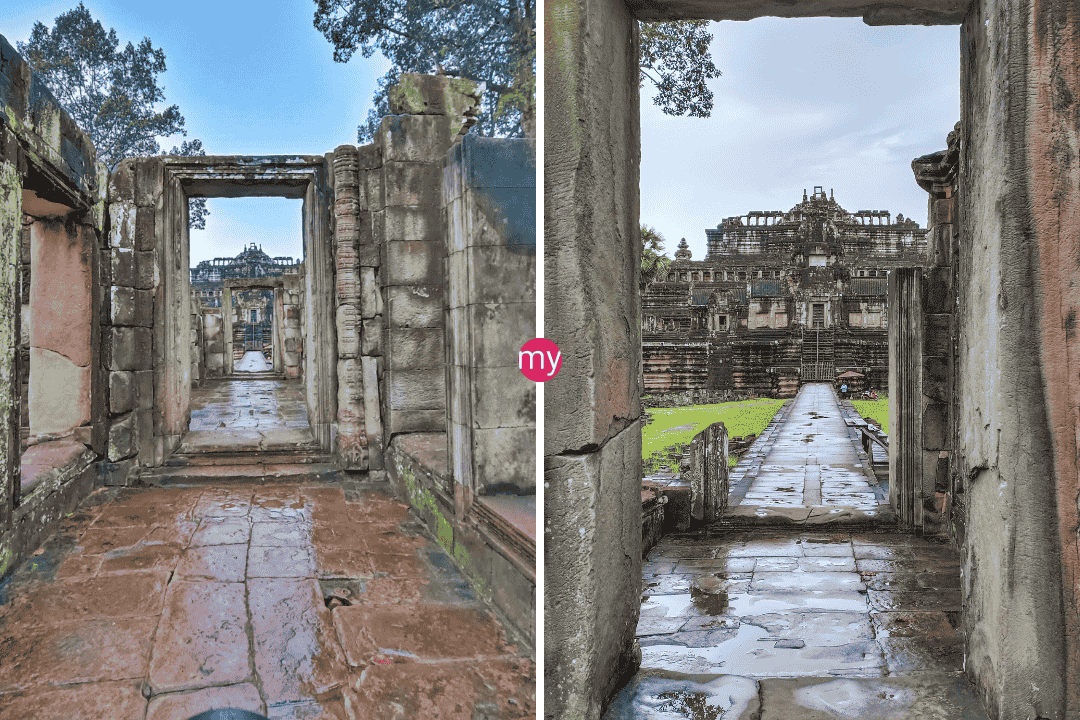
Most visitors prioritize Bayon for its iconic imagery and easier access, but skipping Baphuon means missing the best vantage point in Angkor Thom and one of Southeast Asia’s most ambitious restoration stories. Bayon vs Baphuon Temple isn’t really a choice – smart travelers hit both in a single morning using the historical axis that connects them.
What Makes Bayon and Baphuon So Different?
Walking through Angkor Thom’s South Gate, you’ll face a decision that shapes your entire temple experience. Turn left toward the center, and you’ll find yourself surrounded by the famous stone faces of Bayon. Continue north along the royal causeway, and you’ll encounter Baphuon’s imposing pyramid rising from the forest floor.
These two monuments sit just 300 meters apart, yet they represent completely different chapters of Khmer civilization, architectural philosophies, and visitor experiences.
The confusion starts because most guidebooks lump them together as “Angkor Thom temples” without explaining why one deserves 90 minutes while the other needs barely 40. Tour operators rush groups through both in a single hour, leaving travelers wondering what they actually saw.
Here’s what nobody mentions upfront: Bayon works as a standalone experience. Baphuon doesn’t. But together? They tell the complete story of how Angkor transformed from Hindu kingdom to Buddhist empire and back again.
Bayon vs Baphuon Temple – The Core Distinction
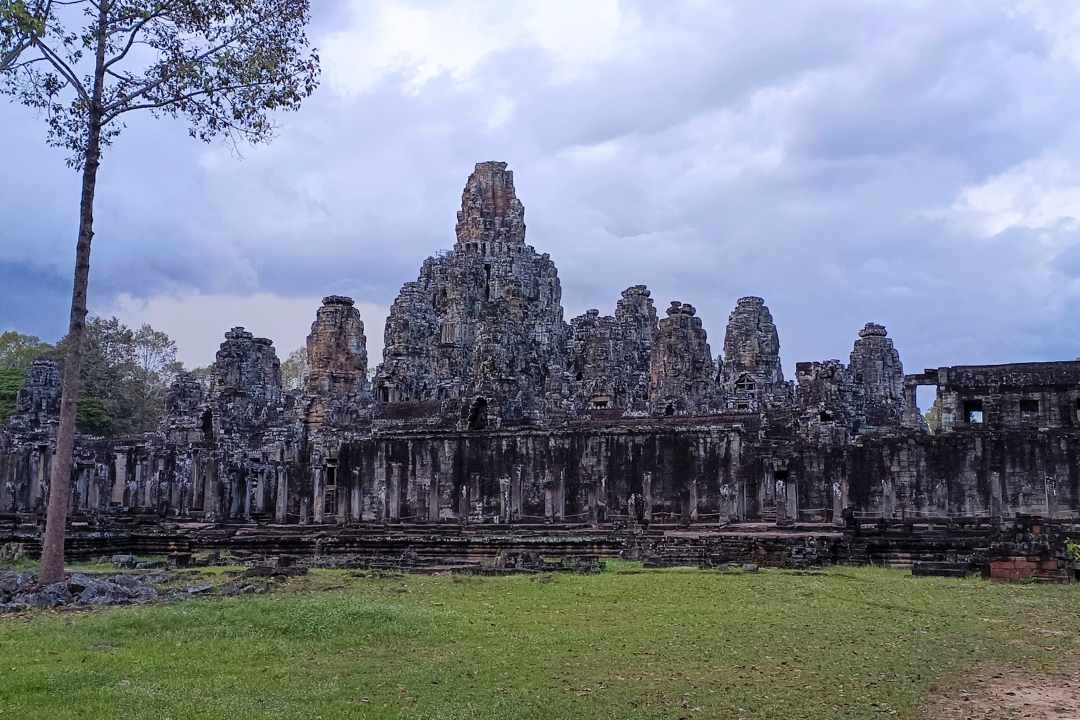
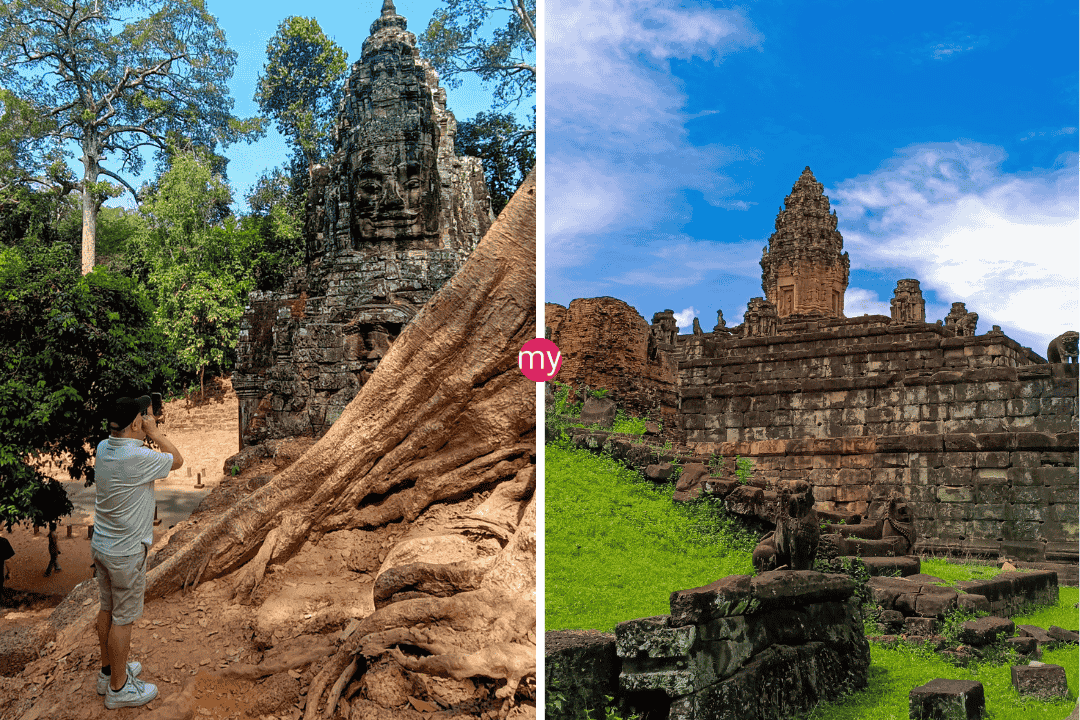
Bayon Temple functions as an outdoor portrait gallery. Every angle reveals another weathered face emerging from the sandstone, creating endless photographic compositions. The temple’s compressed, labyrinthine layout forces intimate encounters with the architecture – you can’t step back for perspective because there’s always another tower, another corridor, another face demanding attention.
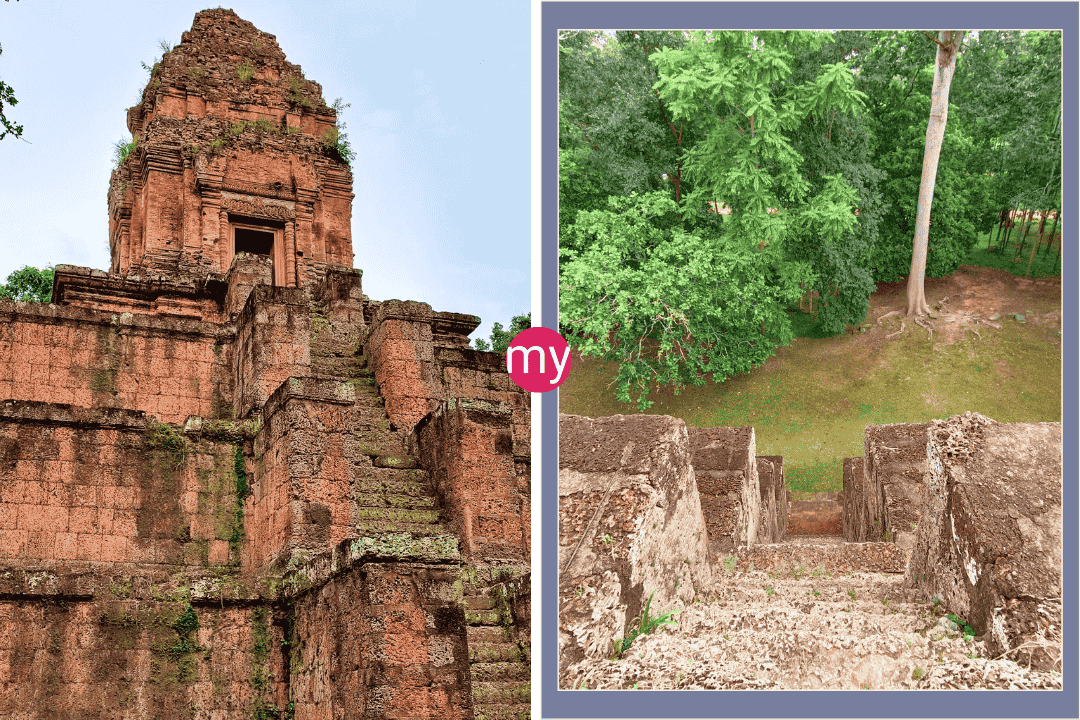
Baphuon Temple operates as an archaeological adventure. The 200-meter elevated causeway approaches a three-tier pyramid that requires physical effort to appreciate. Once you climb those steep wooden stairs to the upper terrace, the reward isn’t more carvings – it’s spatial understanding of how Angkor Thom’s entire urban grid functioned as a cosmic diagram.
Most comparison articles miss this fundamental truth: Bayon optimizes for emotional impact through repetition and enclosure. Baphuon optimizes for intellectual understanding through scale and elevation.

When Each Temple Was Built (And Why That Matters)
Baphuon: The 11th Century Foundation (1050-1066 AD)
King Udayadityavarman II commissioned Baphuon as the state temple of his capital, decades before Angkor Thom existed. The temple originally honored Shiva through classic Hindu temple-mountain symbolism – a pyramidal structure representing Mount Meru, the cosmic axis.
Chinese diplomat Zhou Daguan visited in 1296 and described Baphuon as “the Tower of Bronze,” referencing a now-lost bronze spire that once crowned the central tower. That spire would have pushed the temple’s height to approximately 50 meters, making it the tallest structure in the Angkor region at the time.
The temple’s foundation rests on sandy soil prone to settling, which created stability problems almost immediately. Medieval builders responded with continuous reinforcement projects that left archaeological evidence of multiple construction phases overlapping within a single generation.
Bayon: The Late 12th Century Revolution (1164-1182 AD)
King Jayavarman VII built Bayon as the centerpiece of his new capital, Angkor Thom, nearly a century after Baphuon’s completion. But this wasn’t just architectural evolution – it was religious revolution.
Jayavarman VII broke with centuries of Hindu tradition by constructing a Mahayana Buddhist state temple. The famous stone faces likely represent Avalokiteshvara, the Bodhisattva of Compassion, though some scholars argue they simultaneously portray the king himself in a deliberate fusion of political and spiritual authority.
The temple underwent three major construction phases during Jayavarman VII’s reign alone. What you see today is actually version 3.0 – the king repeatedly ordered expansions that buried earlier versions within the current structure. Modern conservation work has revealed these hidden layers, showing how the design evolved from a relatively simple shrine to the baroque complexity visible today.
After Jayavarman VII’s death, subsequent Hindu kings attempted to “correct” Bayon by removing Buddhist imagery and adding Hindu gods. King Jayavarman VIII’s iconoclastic campaign (late 13th century) explains why you’ll find crudely carved Hindu deities alongside sophisticated Buddhist reliefs – the vandalism became part of the temple’s history.
The Timeline Gap
That century between Baphuon (1050-1066) and Bayon (1164-1182) represents one of the Khmer Empire’s most turbulent periods. Wars with Champa, succession crises, and religious conflicts destabilized the kingdom. When Jayavarman VII finally seized power and built Angkor Thom, he deliberately positioned his new capital to supersede earlier ceremonial centers.
This explains why Baphuon feels geographically awkward within Angkor Thom’s layout – because it predates the city walls by over a century. The elevated causeway leading to Baphuon originally connected to an entirely different urban grid that Jayavarman VII’s construction crews partially demolished and rebuilt.

Bayon vs Baphuon Temple – Architecture and Design: The Technical Breakdown
Bayon’s Maze of Faces
| Feature | Original State | Current Condition |
|---|---|---|
| Face Towers | 54 towers with 216 faces | 37 towers with 173 visible faces |
| Central Tower Height | 43 meters above ground | 43 meters (structurally stable) |
| Base Dimensions | 140m x 160m | Unchanged |
| Bas-Relief Length | Over 1,200 linear meters | Approximately 75% intact |
The architectural genius of Bayon lies in its violation of classical Khmer temple rules. Traditional temple-mountains feature clear axial symmetry and gradual terracing. Bayon abandons both principles.
The ground plan resembles a compressed forest where towers cluster without obvious geometric logic. Corridors dead-end unexpectedly. Staircases lead to platforms that connect to nothing. This apparent chaos actually follows a sophisticated program where the temple’s three construction phases layered on top of each other without demolishing earlier work.
Walk the outer gallery’s bas-reliefs and you’re touring the first construction phase – a relatively conventional single-story temple. Climb to the middle terrace and you’re in phase two, where Jayavarman VII added a second story and more towers. Reach the central sanctuary and you’ve entered phase three, where the king ordered yet another expansion that surrounded the existing structure with additional face towers.
The famous faces themselves follow strict proportional rules despite appearing spontaneous. Each measures approximately 3-4 meters from crown to chin. The serene expressions derive from identical carving templates applied across all towers, creating visual unity despite the compressed layout.
Baphuon’s Pyramid Logic
| Feature | Specification | Challenge Level |
|---|---|---|
| Pyramid Tiers | 3 primary levels | Steep climb required |
| Current Height | 34 meters (originally ~50m) | Extensive elevation gain |
| Base Dimensions | 120m x 100m | Massive footprint |
| Approach Causeway | 200 meters elevated | Dramatic but accessible |
| Reclining Buddha | 70m long, 9m high | Visible from ground level |
Baphuon’s design follows textbook Hindu temple-mountain principles. A three-tier pyramid rises in increasingly steep gradients, symbolizing the three realms of Hindu cosmology. The central sanctuary originally crowned the summit, housing a linga representing Shiva.
The temple’s innovation lies in its gallery system. Unlike earlier pyramidal temples with minimal interior space, Baphuon features extensive galleries running around each terrace. These galleries originally displayed bas-reliefs depicting Hindu mythology, though erosion and deliberate defacement have destroyed most original carvings.
The famous reclining Buddha emerged centuries after the temple’s construction. In the 15th-16th centuries, when Theravada Buddhism replaced Angkor’s earlier religions, local Buddhists systematically dismantled the central tower and repurposed the stones to create a massive reclining Buddha along the western retaining wall. This 70-meter sculpture represents one of Southeast Asia’s largest Buddha images, though its crude construction style contrasts sharply with the sophisticated 11th-century stonework surrounding it.
The temple’s structural problems stem from its foundation. Built on sandy soil with inadequate load distribution, Baphuon began settling almost immediately after construction. Medieval builders attempted repairs by adding buttresses and reinforcement layers, but these patches created as many problems as they solved by adding uneven weight distribution.
The Restoration Stories
Baphuon: The World’s Largest 3D Jigsaw Puzzle
Between 1960 and 2011, Baphuon underwent what conservation experts call the most ambitious anastylosis project ever attempted. French archaeologists from the École française d’Extrême-Orient (EFEO) systematically dismantled the collapsing temple, cataloged 300,000 individual stones, then spent decades reconstructing the pyramid with modern engineering reinforcement.
Then the Khmer Rouge seized power in 1975 and destroyed all the documentation.
For 16 years, the temple sat as a field of numbered stones with no blueprint for reassembly. When EFEO teams returned in 1995, they faced an archaeological nightmare: reconstruct a medieval temple using logic, geometry, and educated guesswork.
The solution involved creating a massive digital database where computer programs tested millions of possible stone configurations. Each stone’s weathering patterns, chisel marks, and adjacent surfaces provided clues about its original position. The team worked systematically from the foundation upward, using temporary scaffolding to test stone arrangements before committing to final placement.
The reopening in 2011 revealed a technically perfect restoration that occasionally sacrifices historical authenticity for structural stability. Walk around the base and you’ll notice modern concrete cores hidden within ancient sandstone facades – controversial compromises that ensure the temple won’t collapse again within our lifetimes.
5. The Airport Drop-Off Option That Maximizes Your Final Day
This is the feature that makes experienced travelers stop and recalculate their entire itinerary. Most visitors waste their last day in Cambodia because they need to check out by 12:00 PM, can’t store luggage easily, and end up sitting at cafes for six hours before their evening flight.
Book Your Koh Ker Adventure with the airport drop-off add-on, and suddenly your departure day becomes productive. Pack your bags, bring your luggage on tour, spend 9 hours exploring Cambodia’s most spectacular jungle temples Cambodia, and get dropped directly at Siem Reap International Airport with perfect timing for flights departing after 7:45 PM.
The tour returns around 6:00 PM, giving you 1 hour 45 minutes before your flight cutoff—ideal for international departures. You’ve just converted a wasted waiting day into an unforgettable temple adventure while simultaneously solving the luggage storage problem.
6. Transparent Pricing That Actually Includes Everything
Let’s break down what “everything included” actually means, because this matters when you’re comparing options:
Included in Your One-Click Booking:
- Luxury air-conditioned minivan (fuel, driver, insurance)
- Professional English-speaking guide (full day rate)
- Beng Mealea temple entrance fee ($10 per person)
- Koh Ker archaeological park entrance fee ($15 per person)
- Hotel pickup and drop-off in Siem Reap
- Unlimited cold bottled water and soft drinks
- Chilled face towels throughout the day
- Local community taxes and tourism fees
Not Included (These Are Your Only Additional Costs):
- Lunch at local restaurant (typically $5-8 per person)
- Personal gratuities (optional, but $10-15 per group is standard)
Compare this to booking independently, where you’ll negotiate transport ($60-80 for a private car), purchase tickets separately ($25 per person), hire a guide independently ($40-50 for the day), and probably pay more because you’re negotiating from a position of limited information.
The one-click system gives you complete cost certainty before you commit. No surprises, no hidden fees, no awkward negotiations about what was “supposed to be included.”

7. Small Group Experience Despite Using a Single Booking Platform
Here’s what makes this different from those massive tour bus operations: when you Book Your Koh Ker Adventure in One Click, you’re booking a private tour. The people in your vehicle are people you chose to travel with—your friends, family, travel companions.
Maximum group size is 10 people, but that’s only if you’re booking for 10 people. Most bookings are 2-4 person private groups who want the intimacy of a personal tour with the convenience of professional organization.
This means you control the pace. Want to spend an extra 15 minutes photographing the overgrown temple ruins at Beng Mealea where tree roots have created that perfect Indiana Jones aesthetic? Your guide adjusts. Need a longer lunch break? No problem—this is your private tour.
The small group structure also creates better guide interaction. Your guide isn’t managing 30 people with varying interests and physical abilities. They’re focused on your specific group, answering your questions, adapting to your photography style, and providing the personalized experience that makes these off the beaten path Cambodia temples truly memorable.
The Restoration Stories
Bayon: The Never-Ending Conservation Project
Unlike Baphuon’s dramatic total reconstruction, Bayon receives continuous incremental conservation that will likely continue for decades. The Japanese Government Team for Safeguarding Angkor (JSA) has worked on Bayon since 1994, focusing on stabilizing the central tower and preserving the bas-reliefs.
The challenge stems from Bayon’s compressed architecture. You can’t dismantle one section without affecting adjoining structures. Modern conservation therefore proceeds tower by tower, using temporary supports while teams repair foundations, replace deteriorated stones, and stabilize carvings.
Walk around Bayon on any given day and you’ll likely encounter scaffolding somewhere. This isn’t evidence of neglect – it’s the reality of maintaining a 840-year-old structure that receives over 800,000 visitors annually.
The bas-reliefs present particular problems. Sandstone carvings exposed to tropical monsoons for eight centuries suffer from biological colonization (lichens, algae, fungi) that slowly dissolves the stone’s surface. Conservation teams apply chemical treatments and controlled cleaning, but complete removal of biological growth would destroy the stone’s patina and historical character.
UNESCO’s 2024 anniversary celebration of 30 years of Bayon conservation highlighted both achievements and ongoing challenges. Significant portions of the outer gallery bas-reliefs now feature protective barriers preventing visitors from touching the carvings – a necessary measure that unfortunately reduces the intimate encounter that makes Bayon special.

Bayon vs Baphuon Temple: The Direct Comparison
| Factor | Bayon Temple | Baphuon Temple |
|---|---|---|
| Construction Date | 1164-1182 AD (Late 12th century) | 1050-1066 AD (Mid 11th century) |
| Original Religion | Mahayana Buddhism | Hinduism (Shiva) |
| Defining Feature | 216 stone faces across 54 towers | Three-tier pyramid with 70m reclining Buddha |
| Accessibility | Easy (minimal climbing required) | Challenging (steep stairs, significant elevation) |
| Time Required | 75-90 minutes | 40-60 minutes |
| Crowd Density | Very High (75-85% of Angkor Thom visitors) | Moderate (45-50% of Angkor Thom visitors) |
| Photography Style | Portrait/detail (faces, bas-reliefs) | Landscape/architectural (pyramid, vistas) |
| Optimal Visiting Time | 8:30-10:00 AM or 12:00-1:30 PM | 7:00-9:00 AM or 3:00-5:00 PM |
The Tours That Get It Right
Most Angkor tours rush through Angkor Thom in 60-90 minutes, treating Bayon and Baphuon as checkbox stops rather than distinct experiences. A few operators structure itineraries that actually match how the temples function.
Private Angkor Wat Mix Temples Photo Tour
The Private Angkor Wat Mix Temples Photo Tour solves the Bayon vs Baphuon Temple timing problem through strategic scheduling. The itinerary visits Angkor Thom during the 11:30 AM – 1:00 PM lunch gap when tour bus crowds temporarily disappear.
This creates a remarkable window at Bayon where the central sanctuary clears enough for unobstructed photography. Yes, the overhead sun produces harsher light than golden hour. But having the face towers mostly to yourself generates images impossible during peak congestion.
The tour then transitions to Baphuon for the physically demanding pyramid climb during the coolest part of midday (the upper terrace catches afternoon breeze). This timing sequence works because Baphuon’s architectural photography doesn’t depend as heavily on optimal sun angles.
Angkor Wat Sunset Tour
The Angkor Wat Sunset Tour approaches Bayon vs Baphuon Temple from the opposite direction. This itinerary prioritizes Bayon during morning light (8:30-10:00 AM), when the eastern sun illuminates the stone faces with warm side-lighting that enhances facial features.
The route then incorporates Baphuon as a walking transition between Bayon and Ta Prohm. Rather than treating Baphuon as a separate destination, the tour uses the 200-meter elevated causeway as a contemplative break between dense architectural experiences.
This approach works for visitors who want to see both temples but prioritize Bayon’s photographic opportunities. Baphuon becomes a supporting element rather than equal co-star.
Private Angkor Wat Sunrise Tour
The Private Angkor Wat Sunrise Tour targets serious photographers willing to start at 5:00 AM for Angkor Wat’s sunrise. After the dawn session, the tour proceeds directly to Bayon around 9:00 AM – arguably the single best time for face tower photography.
Baphuon appears as an optional add-on for visitors with remaining energy after the intensive sunrise-to-midday photography session. This structure acknowledges that cramming too many temples into one morning dilutes the experience.
The sunrise tour works because it matches visitor energy levels to temple difficulty. Early morning adrenaline carries you through Angkor Wat and Bayon’s detail-focused experiences. By the time you reach Baphuon, you’re using the pyramid climb as physical activity that counterbalances hours of careful photography.
What These Tours Understand
The common thread? All three tours recognize that Bayon vs Baphuon Temple isn’t about competition but about sequencing. Bayon demands mental engagement with intricate details and overwhelming quantity (173 faces, 1,200 meters of bas-reliefs). Baphuon demands physical engagement with spatial relationships and architectural logic.
Combining both requires understanding how your energy, attention span, and photographic priorities shift throughout a temple visit. Generic tours ignore these factors, producing exhausted visitors who remember neither temple clearly.
Related Temple Comparisons Worth Exploring
Understanding Bayon vs Baphuon Temple opens questions about other Angkor temple pairings. Similar comparisons reveal how different monuments complement or contrast with each other:
Ta Prohm vs Bayon Temple examines how jungle reclamation at Ta Prohm creates a completely different aesthetic than Bayon’s cleared, maintained condition. Both are 12th-century Buddhist temples by Jayavarman VII, yet they offer opposite visitor experiences.
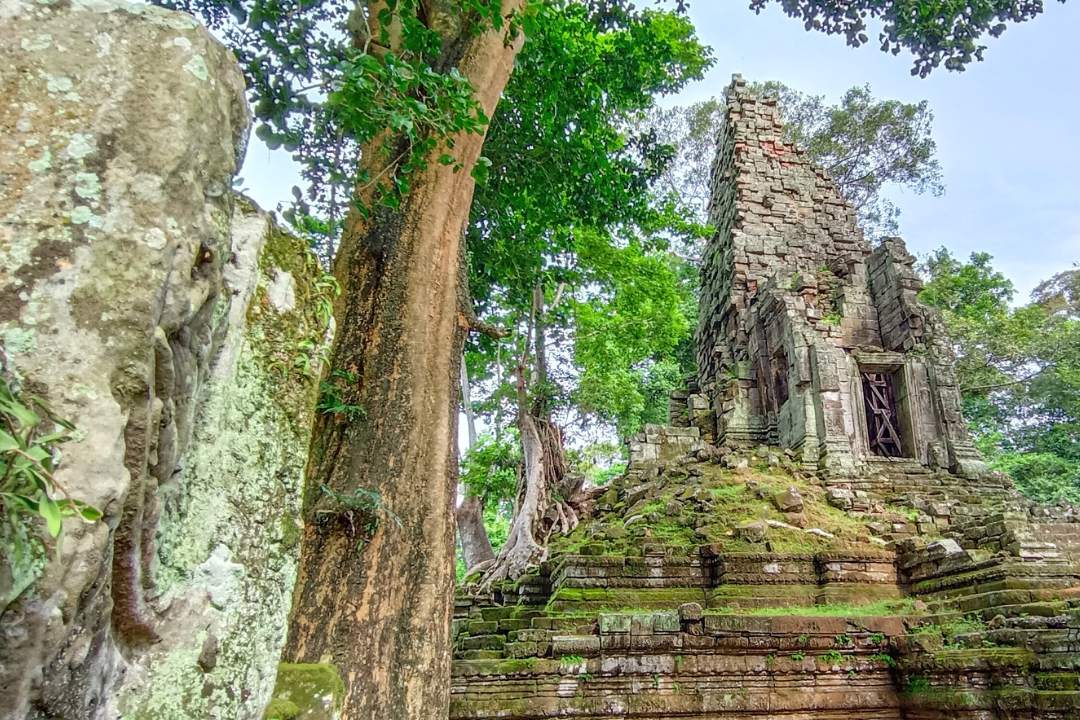
Prasat Preah Palilay vs Baphuon Temple compares Baphuon’s monumental pyramid to a small forest temple nearby. The contrast illustrates how royal state temples differ from lesser shrines in scale and ambition.
Angkor Wat Small Circuit vs Grand Circuit explains the two standard tour routes through Angkor Archaeological Park. Bayon appears on both circuits, while Baphuon gets included only on extended itineraries.
The Real Answer: You Need Both
After examining architecture, history, visitor experience, and conservation achievements, the conclusion becomes obvious: Bayon vs Baphuon Temple is a false dilemma.
Bayon delivers emotional impact through overwhelming repetition of a single visual motif – those serene stone faces emerging from every angle. It’s theatrical, visceral, and immediately photographable. You don’t need context or explanation to appreciate Bayon’s power.
Baphuon provides intellectual satisfaction through spatial relationships and historical layering. The temple rewards preparation, physical effort, and architectural literacy. You need context to appreciate what you’re seeing – but once you understand the restoration achievement, the religious syncretism, and the urban planning implications, Baphuon reveals depths that Bayon can’t match.
These aren’t competing experiences. They’re complementary halves of Angkor Thom’s story.
Walking the 300-meter path between them replicates the historical transition from classical Hindu temple-mountains (Baphuon) to compressed Buddhist ceremonial centers (Bayon). Skipping one cuts that narrative in half.
Most visitors allocate 3-4 hours minimum for Angkor Wat. Bayon and Baphuon combined deserve 2-2.5 hours. The temples sit literally next door to each other. Not visiting both is like touring the Louvre but skipping either the Mona Lisa or Venus de Milo because you “already saw enough art.”
So the answer to Bayon vs Baphuon Temple? Stop choosing. See both. Budget adequate time. Follow the historical axis from Bayon north to Baphuon. Let the temples tell their complete story instead of forcing them to compete.
Making It Happen: Your Complete Temple Visit
Looking at those tour options again: the Private Angkor Wat Mix Temples Photo Tour, Angkor Wat Sunset Tour, and Private Angkor Wat Sunrise Tour all incorporate both temples with strategic timing that actually matches how they function.
The difference between a rushed checkbox visit and a meaningful temple experience comes down to sequencing and time allocation. Generic tours treat both temples as 15-minute photo stops. Thoughtful itineraries give Bayon 75-90 minutes, Baphuon 45-60 minutes, with walking transitions that provide rest between intensive experiences.
When you book through My Siem Reap Tours, you’re working with guides who understand that Bayon’s faces need morning light, that Baphuon’s climb requires cool temperatures, and that the lunch-hour gap offers the best crowd-free windows at major monuments.
The temples won’t change. Your energy level will. Your attention span will. The quality of light will. Professional tour planning accounts for all these variables instead of pretending every temple fits the same visit pattern.
Want to go deeper into other Angkor comparisons? Check out Koh Ker vs Beng Mealea for remote temple adventures, or explore Ta Prohm Temple vs Bakong Temple vs Prasat Beng Mealea for three-way architectural comparisons spanning different centuries and styles.
The Angkor Archaeological Park contains over 400 structures across 400 square kilometers. Understanding which temples complement or contrast with each other transforms random sightseeing into coherent narrative exploration.
Bayon vs Baphuon Temple
Bayon vs Baphuon Temple comparison helps visitors choose between Angkor Thom’s two most architecturally significant monuments. Bayon Temple delivers 216 iconic stone faces across 37 towers in a compact labyrinthine layout perfect for intimate photography and detailed bas-relief exploration. Baphuon Temple offers a physically challenging three-tier pyramid climb rewarded with panoramic city views and a massive 70-meter reclining Buddha representing 15th-century religious transformation.
Key features of Bayon Temple:
- 173 Surviving Faces: The famous stone visages of Avalokiteshvara (possibly merged with King Jayavarman VII) create endless photographic compositions across multiple viewing angles
- 1,200 Meters of Bas-Reliefs: Outer gallery carvings document Khmer military campaigns, daily life, naval battles, and religious practices with documentary precision
- Compressed Architecture: Three construction phases layered on top of each other create a maze-like experience where spatial orientation becomes intentionally difficult
- Central Sanctuary Access: Multiple routes to the upper terrace allow flexible exploration despite crowd congestion
- Optimal Morning Light: 8:30-10:00 AM window provides ideal illumination for face tower photography
Key features of Baphuon Temple:
- Three-Tier Pyramid Structure: Classic Hindu temple-mountain design representing Mount Meru, requiring significant physical effort to reach upper terraces
- 200-Meter Elevated Causeway: Dramatic approach across former sacred pond creates anticipation and excellent photography perspective
- 70-Meter Reclining Buddha: Massive 15th-century Buddhist sculpture built into western retaining wall demonstrates religious syncretism
- Panoramic Vantage Points: Upper terrace views reveal Angkor Thom’s spatial layout and relationship between monuments
- Restoration Achievement: 51-year reconstruction (1960-2011) successfully reassembled 300,000 stones without original documentation
Tour options including both temples:
- Private Mix Temples Photo Tour – Strategic midday timing for reduced crowds
- Sunset Tour – Morning Angkor Thom visit before sunset locations
- Sunrise Tour – Post-dawn Bayon photography at optimal light
Remember that:
- Single-day Angkor passes ($37 USD) cover both temples within Angkor Archaeological Park
- Digital tickets available through Angkor Enterprise booking system eliminate queuing
- Both temples require modest dress (shoulders and knees covered)
- Morning visits (before 10:00 AM) provide best combination of light, temperature, and crowd conditions
- The 300-meter walking distance between temples allows easy combined visits following historical royal axis
Ready to experience both temples with expert timing and crowd strategy? Connect with My Siem Reap Tours to design itineraries that match your photography priorities, physical capabilities, and available time.
For media inquiries about Angkor temple comparisons and tour strategy, visit our media and press section.
Relevant Resources
You’ve made it this far – here’s what to explore next:
- Angkor Enterprise Official Site – Current ticket pricing, park regulations, and official visitor statistics
- Ta Keo Temple vs Pre Rup Temple – Compare two pyramid temples from different eras
- Preah Khan vs Banteay Kdei – Explore sprawling monastery temples with opposite visitor densities
- Banteay Samre Temple vs Ta Prohm vs Eastern Mebon Temple – Three-way comparison spanning different architectural styles
- Ta Prohm vs Banteay Srei – Contrast jungle temples with miniature pink sandstone masterpieces
These comparisons help you understand not just individual temples but how they function within larger tour circuits and historical narratives.
Brought to you by Dan and Mat, Your tour planners.
Featured
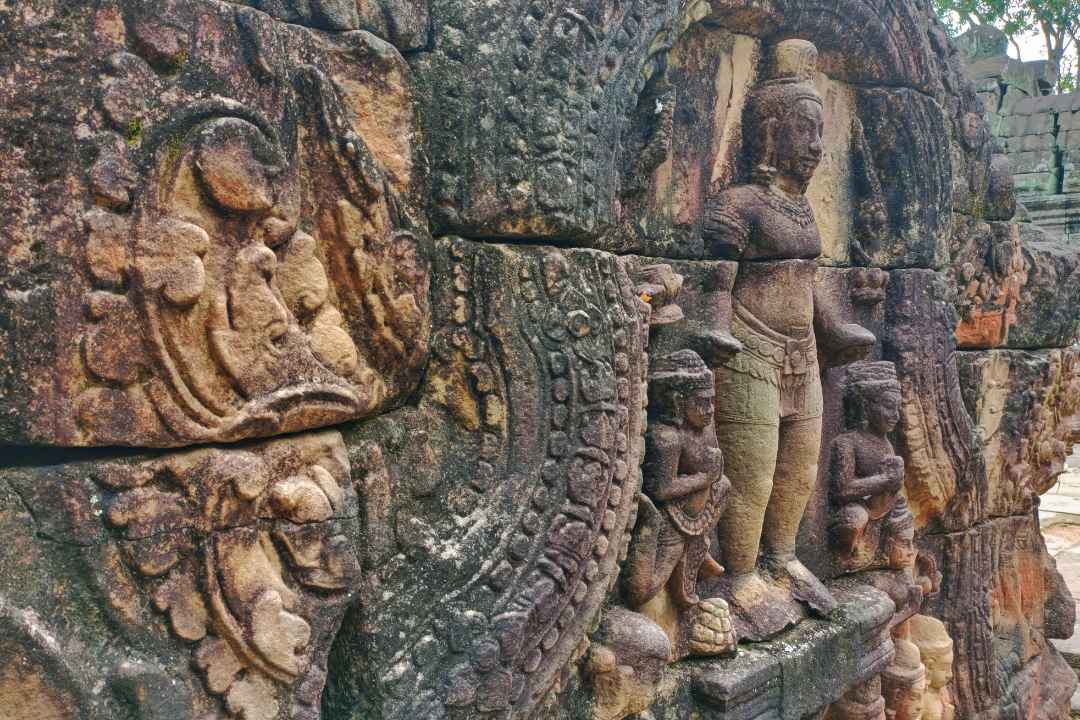

Explore more on My Siem Reap Tours
Koh Ker and Beng Mealea guided tour | Banteay Srei temple guided tour | Angkor Wat Sunrise tour | Private Angkor Wat Sunset Tour | Koh Ker and Beng Mealea guided tour | Morning Siem Reap floating village tour | Afternoon Siem Reap floating village tour | Private Angkor Wat special tour | Kulen Waterfall small group guided Tour | Private Angkor Wat mix temples photo tour